PTE
Is PTE Really Easier Than IELTS? A Practical Comparison for Indonesian Test Takers
A practical guide for Indonesian test takers comparing PTE and IELTS based on test pressure, result speed, speaking format, writing style, and target acceptance.
by Katalab Editorial Team
May 18, 2026
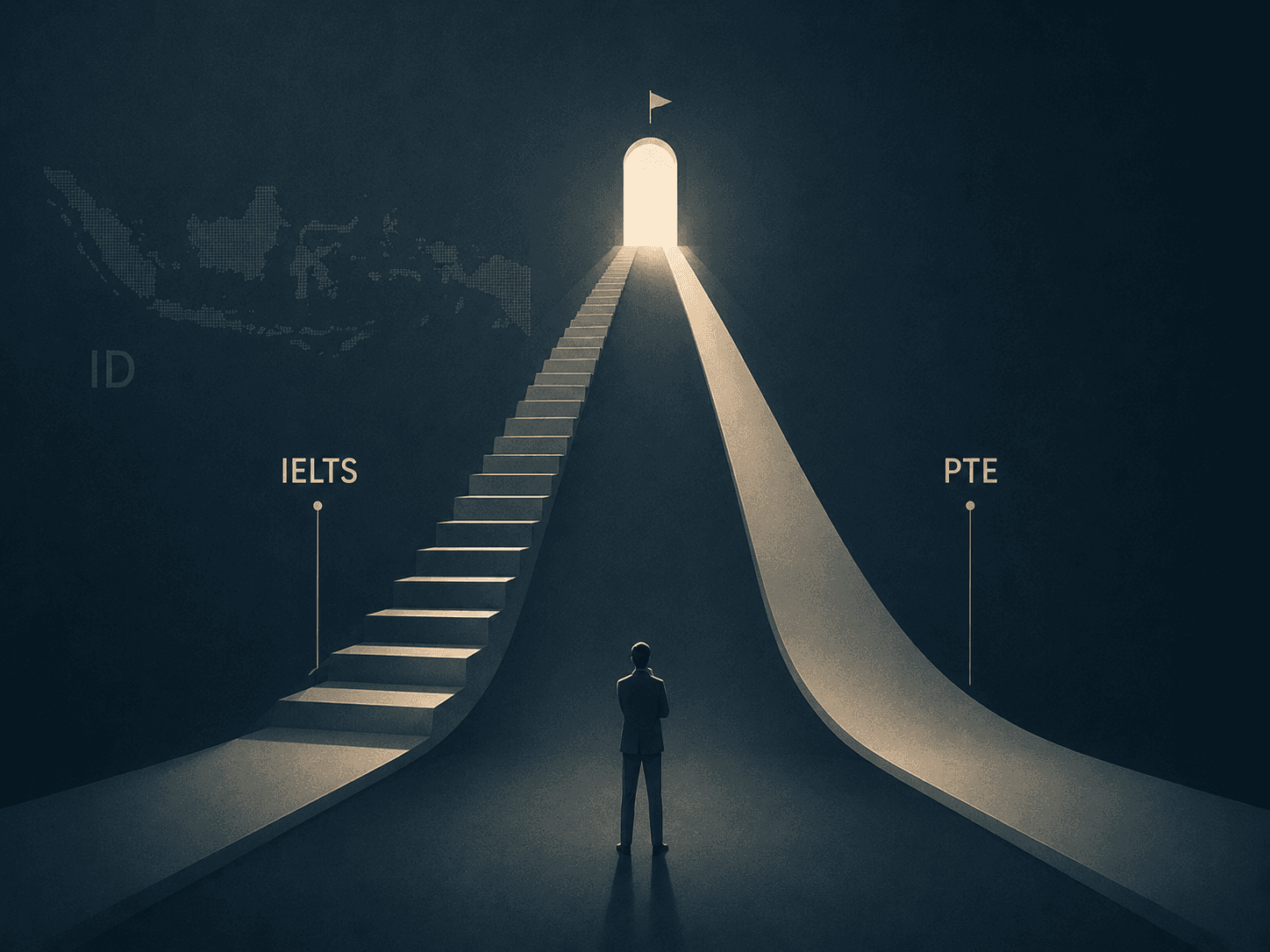
The wrong question
Many Indonesian students and migration applicants ask the same question: “Is PTE easier than IELTS?”
The honest answer is: sometimes yes, sometimes no. PTE may feel easier if you are comfortable with computers, fast tasks, typing, and speaking into a microphone. IELTS may feel easier if you prefer a familiar exam format, human speaking interaction, and essay-style writing.
Why many Indonesians think PTE is easier
PTE has a strong reputation among test takers because it feels more modern and predictable. The test is computer-based, the results are usually fast, and many tasks can be trained with repeated practice.
Pearson states that PTE Academic uses AI scoring and reports performance through an overall score and skill information. Pearson also states that score reports are typically sent within 48 hours after the test.
| Reason PTE feels easier | What it means in practice |
|---|---|
| Fast result turnaround | Useful when university, visa, or scholarship deadlines are close. |
| Computer-based scoring | Some learners feel less nervous because there is no face-to-face examiner. |
| Repeatable task patterns | Many tasks can be trained through technique, rhythm, and timing. |
| Integrated skills | One task can support several skill areas, but this can also become a risk. |
Why IELTS may still be safer for many applicants
IELTS is familiar to many institutions, scholarship bodies, migration agents, and English teachers. IELTS reports scores on the 0 to 9 band scale, and the overall band score is calculated from the average of Listening, Reading, Writing, and Speaking.
For some Indonesian learners, the human Speaking test is not a weakness. It can be an advantage. If you explain ideas better in conversation than into a microphone, IELTS Speaking may feel more natural.
| IELTS strength | Why it matters |
|---|---|
| Clear four-skill structure | Listening, Reading, Writing, and Speaking feel more separated. |
| Human Speaking test | Good for candidates who speak better in real conversation. |
| Widely recognised band score | Many institutions clearly understand IELTS bands. |
| Essay-based writing | Good for learners who can organise arguments and examples. |
The practical difference is pressure
The main difference is not that one test is always easier. The main difference is pressure. IELTS and PTE pressure the learner in different ways.
| Pressure type | IELTS | PTE |
|---|---|---|
| Speaking pressure | Face-to-face communication with an examiner | Microphone speaking with automated scoring |
| Writing pressure | Essay-style paragraph control and idea development | Computer-based writing with task technique and accuracy |
| Timing pressure | Careful reading, essay planning, and section timing | Fast task movement, typing control, and response timing |
| Score pressure | Band scores are widely understood | Score interpretation depends more on institutional acceptance |
The deadline factor: PTE often wins on speed
For Indonesian applicants, the deadline is often the real problem. Students may need a score quickly for university admission, a scholarship deadline, or an Australian visa process.
| Test option | Typical result timing | Planning meaning |
|---|---|---|
| PTE Academic | Usually within 48 hours | Useful when the deadline is close and the target accepts PTE. |
| IELTS on computer | Usually faster than paper-based IELTS | Can still be practical for applicants with some buffer. |
| IELTS on paper | Usually longer result wait | Needs more planning time before deadline. |
Who may prefer PTE?
PTE may be a better option for Indonesian test takers who are comfortable with technology and prefer a system-based exam. It may also suit candidates who dislike face-to-face speaking tests or need a faster result for application planning.
| PTE may fit you if... | Reason |
|---|---|
| You type quickly and accurately | Typing speed helps in writing and listening-related tasks. |
| You speak clearly into a microphone | PTE Speaking rewards fluency, clarity, and timing. |
| You like repeated task patterns | PTE preparation can be highly technique-based. |
| You need faster results | Useful when you are close to a deadline. |
| Your target accepts PTE clearly | Acceptance is the first requirement, not preference. |
Who may still prefer IELTS?
IELTS may be better for test takers who prefer a more traditional exam experience. It is also useful for candidates who want a test that is widely recognised across study, migration, and professional contexts.
| IELTS may fit you if... | Reason |
|---|---|
| You speak better with a real person | The interview format may feel more natural than speaking to a computer. |
| You are strong at essay writing | IELTS Writing rewards paragraph control and idea development. |
| You prefer separated skills | Listening, Reading, Writing, and Speaking are easier to mentally separate. |
| Your target institution asks for IELTS specifically | Some institutions or pathways still name IELTS clearly. |
| You want a widely understood score system | The 0–9 band system is familiar to many offices and teachers. |
The biggest mistake: choosing from rumours
The most dangerous advice is simple advice: “Take PTE, it is easier” or “Take IELTS, it is safer.” Both can be true in the right situation, and both can be wrong in the wrong situation.
| Common rumour | Better question |
|---|---|
| PTE is easier. | Easier for which skill profile? |
| IELTS is more respected. | Does my target institution require or prefer it? |
| PTE is faster. | Is fast useful if my target does not accept it? |
| IELTS Writing is impossible. | Is my real issue writing skill or test strategy? |
| Computer scoring is fairer. | Can I perform well with microphone and timing pressure? |
A simple decision guide
Before registering for a test, Indonesian test takers should answer five practical questions.
- 1.Is the test accepted by my exact university, scholarship, visa, or professional body?
- 2.Do I need the score quickly, or do I have enough time for IELTS result release and possible retake?
- 3.Am I better at speaking to a person or speaking into a microphone?
- 4.Am I stronger in essay writing or fast computer-based tasks?
- 5.Do I have enough time to learn the format properly, not just practise random questions?
Conclusion
For Indonesian test takers, PTE is not automatically easier than IELTS. It is only easier when the format matches the learner.
PTE can be attractive because it is fast, computer-based, and technique-friendly. IELTS can be safer because it is widely recognised, clearly structured, and more human in the Speaking test.