Research
Indonesia Is Already Polyglot. So Why Is English Still Difficult?
A research-based article on Indonesia’s multilingual strength, the gap between language diversity and academic English performance, and why learners need structured language-transfer training.
by Katalab Editorial Team
May 18, 2026
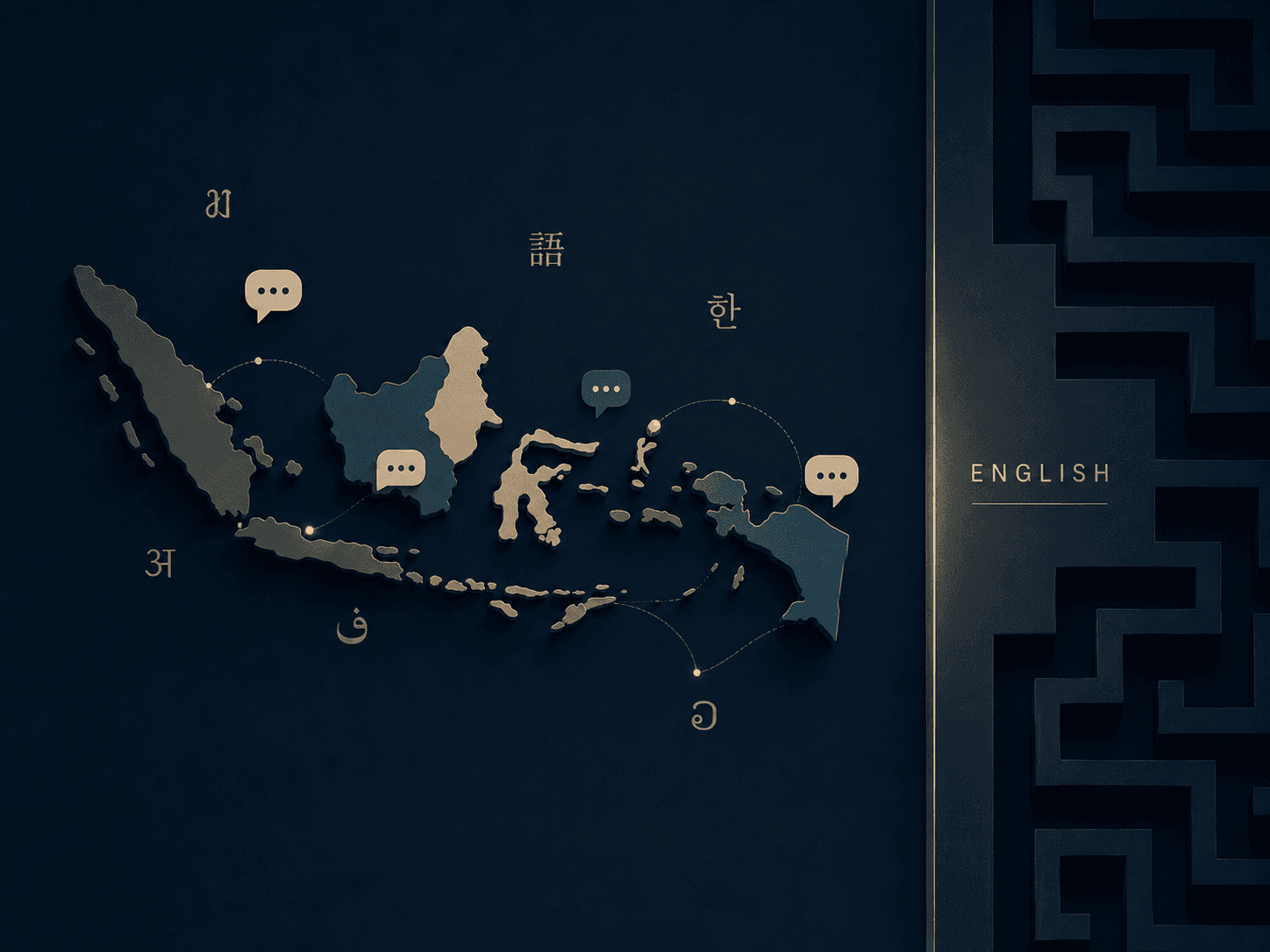
Indonesia does not lack language talent
Indonesia is often described as a country that needs to learn English better. But that statement is too simple. Indonesia is not a monolingual country struggling with language. It is one of the most linguistically rich countries in the world.
Badan Bahasa reports that Indonesia has 718 regional languages. This means English education in Indonesia does not happen in an empty language space. It happens inside a society where many people already move between local languages, Bahasa Indonesia, and English exposure.
So the more useful question is not “Why are Indonesians bad at English?” The better question is: if Indonesians are already multilingual, why does academic English still feel difficult?
Indonesia is language-rich, not language-poor
718
Regional languages
Reported by Badan Bahasa
80 / 123
EF EPI 2025 rank
Indonesia global position
471
EF EPI score
Low proficiency band
65%
English as L3
South Sulawesi Gen Z sample
Many countries teach second languages mainly through formal education. Indonesia is different because multilingualism often exists before English learning begins.
In many families, children grow up hearing or using a regional language, then learn Bahasa Indonesia as the national language. Later, they meet English through school, exams, internet content, entertainment, or scholarship requirements.
The Indonesian learner often has more language experience than they realise
Many Indonesian learners naturally move between language systems every day. They may use a local language at home, Bahasa Indonesia at school or work, English phrases online, and formal English when preparing for scholarships or international study.
| Context | Possible language used |
|---|---|
| Family conversation | Javanese, Sundanese, Balinese, Bugis, Minang, Madurese, or another local language |
| School or office | Bahasa Indonesia |
| Social media | Bahasa Indonesia with English phrases |
| Religious or cultural context | Arabic terms, local language, and Indonesian |
| Academic or scholarship context | Formal English |
This ability to move between contexts is powerful. But academic English is not just another casual language layer. It requires formal vocabulary, paragraph logic, argument development, careful reading, and precise writing.
The polyglot advantage does not automatically become a test advantage
A common misunderstanding is that if someone speaks more than one language, they should easily succeed in English tests. Multilingual experience can help with language awareness, flexibility, and confidence. However, IELTS, TOEFL, PTE, and scholarship writing require a more specific kind of English control.
| Test skill | What it really requires |
|---|---|
| Reading | Understanding long texts, argument flow, paraphrasing, and inference |
| Writing | Building clear paragraphs, supporting ideas, and using formal grammar |
| Listening | Following academic talks, details, and speaker purpose |
| Speaking | Organising answers clearly under time pressure |
Indonesia’s English challenge is visible in proficiency data
The EF English Proficiency Index 2025 places Indonesia at global rank 80 out of 123 countries and regions, with a national score of 471, in the low proficiency band.
| Indicator | 2025 data |
|---|---|
| Indonesia global ranking | 80 / 123 |
| Indonesia EF EPI score | 471 |
| Proficiency band | Low |
| Main interpretation | English test readiness remains uneven |
English often becomes a third language layer
A 2025 study on Generation Z multilingualism in South Sulawesi found that 63.3% of respondents used Indonesian as their first language, followed by Bugis at 18.3% and Makassarese at 15%. For third-language use, English dominated at 65%.
| Language finding | Percentage |
|---|---|
| Indonesian as first language | 63.3% |
| Bugis as first language | 18.3% |
| Makassarese as first language | 15% |
| English as third-language use | 65% |
The real gap is academic control, not only vocabulary
Many Indonesian learners already know English words from the internet, music, movies, games, apps, product names, and social media. But test English is different from exposure English.
| Exposure English | Academic / test English |
|---|---|
| Short captions | Long passages |
| Common phrases | Precise vocabulary |
| Casual comments | Logical arguments |
| Translation-based meaning | Paraphrase recognition |
| Sentence-level understanding | Paragraph-level analysis |
| Passive reading | Timed performance |
Bahasa Indonesia strength can help English writing
There is a hidden opportunity here. Students who can explain ideas well in Bahasa Indonesia often have a foundation for English writing because they already understand reasoning, examples, paragraph movement, and audience awareness.
| Strong skill in Indonesian | Transfer to English |
|---|---|
| Explaining a reason | Building a supporting sentence |
| Giving an example | Developing a paragraph |
| Comparing two ideas | Writing contrast sentences |
| Summarising a text | Academic reading response |
| Writing formal school assignments | IELTS, TOEFL, PTE, and scholarship writing preparation |
The translation ceiling problem
Many learners begin English through translation. That is normal. But if they stay there too long, they can hit a ceiling. They think in Indonesian, translate word by word, and then produce English that sounds unnatural.
| Stage | Example |
|---|---|
| Indonesian idea | Saya setuju karena pendidikan sangat penting untuk masa depan anak. |
| Word-by-word English | I agree because education very important for future child. |
| Controlled academic English | I agree because education plays an important role in shaping a child’s future. |
Reading is the bridge to academic English
For Indonesian learners, reading is not only comprehension practice. It is the bridge between multilingual experience and academic English control.
Language-transfer pathway
Reading shows learners how English sentences are built, how paragraphs move, how arguments develop, and how formal vocabulary works in context.
Writing is the proof of real English control
Writing is the clearest evidence of whether a learner can control English. A learner can guess meanings while reading, use subtitles while listening, or understand English content passively. But writing forces the learner to produce structure.
Writing control ladder
This is why IELTS Writing, TOEFL Writing, PTE written tasks, scholarship essays, motivation letters, and university assignments are difficult. They require controlled output, not just exposure.
Indonesia needs language transfer, not just more English
The ordinary solution is “study more English.” The better solution is “train language transfer.” This means helping learners move from local and Indonesian language intelligence into English reading awareness, sentence control, paragraph control, and test or scholarship performance.
| Goal | Needed transfer |
|---|---|
| IELTS Reading | From general reading to paraphrase and inference |
| IELTS Writing | From Indonesian argument to English academic paragraph |
| TOEFL | From understanding ideas to integrated academic response |
| PTE | From language familiarity to fast computer-based accuracy |
| Scholarship essay | From personal story to structured persuasive writing |
| Study abroad | From classroom English to academic survival English |
Conclusion
Indonesia is already a multilingual country. Many Indonesians grow up managing more than one language, switching between home, school, social, cultural, and formal contexts. That is not weakness. That is an advantage.
But English for IELTS, TOEFL, PTE, scholarships, and university study requires a different kind of language ability. It requires academic reading, formal writing, precise vocabulary, paragraph logic, and test-ready performance.
Article sources
- Badan Pengembangan dan Pembinaan Bahasa. (2025). Masa Depan Bahasa Daerah.
- EF Education First. (2025). EF English Proficiency Index: Indonesia country page / fact sheet.
- Cendekia / Jurnal P4I. (2025). Multilingualisme pada Generasi Z dan Upaya Pemertahanan Bahasa.
- Garuda Kemdiktisaintek. (2025). Metadata page for the same Cendekia article.
- Secretariat Cabinet of Indonesia. (2023). Merdeka Belajar untuk Revitalisasi Bahasa Daerah yang Terancam.